Registered Apprenticeship (RA) is a proven pathway for all career seekers, including young people ages 16–24. Employers, educators, workforce professionals, unions, state agencies, and other partners work together nationwide to offer RAs that blend paid, on-the-job experience with technical instruction, often delivered through community and technical colleges that can lead to college credit or even a 2- or 4-year degree, in addition to a nationally recognized credential. Many Registered Apprenticeships connect with CTE, dual enrollment, and pre-apprenticeship opportunities that give young people early exposure to in-demand skills before entering a Registered Apprenticeship. These pathways allow young professionals to continue their education, start work, or do both by building skills that lead to good jobs with an average starting salary of $86,000 and strong long-term career growth.

PAID JOB
Earn a competitive wage from day one

EDUCATION
Gain knowledge from on-the-job learning and job-related classroom training

CREDENTIALS
Earn a portable credential within your industry
Through Registered Apprenticeships:
- Young people engage in work-based, experiential learning and can further their education through related instruction, often provided by community and technical colleges.
- Schools find new ways to engage students, connecting them to career pathways during their secondary education, increasing the potential for career success.
- Businesses gain access to a talent pipeline of entry-level workers that can address talent shortages in the workplace.
- Out-of-school youth and young adults can utilize Registered Apprenticeships as an alternative pathway to gain experience, industry-recognized skills, earn wages while learning, and re-engage in education and career development outside traditional classroom settings.
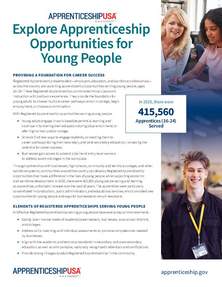
Through partnerships with businesses, high schools, community and technical colleges, and other workforce systems, communities around the country can develop apprenticeships for young people that make a difference while supporting economic and workforce development. In 2025, 415,560 young apprentices were served, a dramatic increase over the past 10 years. The apprentices were particularly concentrated in the construction, public administration, and educational service industries.
Common Pathways to Registered Apprenticeships for Young People
Most pathways fall into one of two types of models:
- Pre-Apprenticeships prepare students to enter a Registered Apprenticeship. An effective pre-apprenticeship is one that, through partnerships with one or more Registered Apprenticeships, enables participants who have successfully completed their pre-apprenticeship to enter directly into a Registered Apprenticeship. Effective pre-apprenticeships should include articulation agreements for earning advanced credit/placement for skills and competencies acquired.
- Students receive instruction directly related to their apprenticeship field, in addition to their required high school coursework, which counts towards high school graduation.
- They participate in on-the-job learning activities, beginning at age 16, which can count toward entry into an apprenticeship.
- Registered Apprenticeships that begin in high school, community college, or through dual enrollment, including CTE programs, allow young people to start their Apprenticeship while still a student.
- Students take courses at their high school or their community or technical college, in addition to their required high school coursework, which counts toward high school graduation or perhaps even towards a 2- or 4-year degree.
- Students may complete their Registered Apprenticeship during high school or continue after graduation, depending on the apprenticeship's duration. For dual enrollment students, the Registered Apprenticeship continues and may be completed at the college.
- The work portion of the apprenticeship is flexible and is done when school is not in session or through a formal work-study program.
Over 93% of Registered Apprenticeship completers are retained as employees. This chain of experiential learning and classroom instruction, connecting high school, CTE, and dual enrollment programs with pre-apprenticeships, which then connect to Registered Apprenticeships, and finally to employment is what many refer to as a skilled workforce pipeline or career pathway.
To find an apprenticeship opportunity near you, use our Apprenticeship Finder tool.
To learn about an apprenticeship near you during National Apprenticeship Week, use our NAW event finder tool.
Help Middle School Students Explore Apprenticeship
It’s not too early for middle school students to start thinking about their future careers and learn how an apprenticeship can serve as a foundation for jumpstarting their careers. The U.S. Department of Labor has collaborated with Scholastic to develop materials to introduce middle school students, parents, and teachers to future careers and apprenticeships. Visit Scholastic’s apprenticeship webpage to download all apprenticeship-related program materials and view profiles of current youth apprentices.

Notable CTE Pre-Apprenticeship Developments
- The Arkansas Certified Pre-Apprenticeship initiative is supported by a U.S. Department of Labor State Apprenticeship Expansion Formula, Round 3 (SAEF3) grant. In addition to a pre-apprenticeship handbook, Arkansas offers a program finder map designed to easily find CTE-connected pre-apprenticeships.
- The Indiana Department of Workforce Development (DWD) Work-Based Learning and Apprenticeship team received a U.S. Department of Labor State Apprenticeship Expansion Formula, Round 3 (SAEF3) grant to expand pre-apprenticeship pathways in manufacturing, construction, healthcare, and IT through CTE-aligned Registered Apprenticeships. The Indiana pre-apprenticeship website offers a breakdown of certified pre-apprenticeship criteria by type in addition to a guide/toolkit for pre-apprenticeship partners.
How to Launch a Registered Apprenticeship for Young People
Through a partnership with the U.S. Department of Labor, the School Superintendents Association (AASA) developed a series of tools designed to inspire new Youth Apprenticeship programs. Check out the AASA Youth Apprenticeship Toolkit designed to help secondary and community college administrators advocate for and build apprenticeship programs.
Evaluation of the Youth Apprenticeship Readiness Grants
- Models of Youth Registered Apprenticeship Expansion: Evidence from the Youth Apprenticeship Readiness Grants
- This report describes the experiences of the DOL-funded Youth Apprenticeship Readiness Grantees (YARG) and organizes the grantees into a typology of youth apprenticeship expansion models.
- Youth Apprenticeship in the United States: Apprenticeship Evidence-Building Portfolio
- This report describes the state of youth apprenticeship in the United States, reviews existing state youth apprenticeship systems, and describes the organization and partnerships of the Youth Apprenticeship Readiness grantees.
Explore Additional Resources for Starting a Registered Apprenticeship for Young People
- Fair Labor Standards Act Factsheet: Information for Interns and Students Working for For-profit Employers
- Wisconsin Department of Public Instruction: Apprenticeship Awareness Toolkit
- Maryland Apprenticeship Connector: Pathway to Your Apprenticeship
- Urban Institute: Mentor Guide for Youth Registered Apprenticeship Programs
- Urban Institute: What High School Educators Can Do to Promote Youth Apprenticeship
- Harvard University Presentation on Expanding Youth Apprenticeships
- Walton Family Foundation and Gallup: Voices of Gen Z studies
See High School Apprenticeship Programs in Action
Check out these videos of current high school apprenticeship programs that are providing meaningful learning opportunities for students.

Apprenticeship Was the Right Path When College Wasn’t
Hear how Jubei found direction and career success through a tech apprenticeship after realizing college wasn’t the right fit.

Apprenticeship Helped Me Earn a Degree and Opened the Door to My Future
Learn how Lydia balanced work and college through the Zurich Apprenticeship Program and transitioned into a full-time role after graduating.